


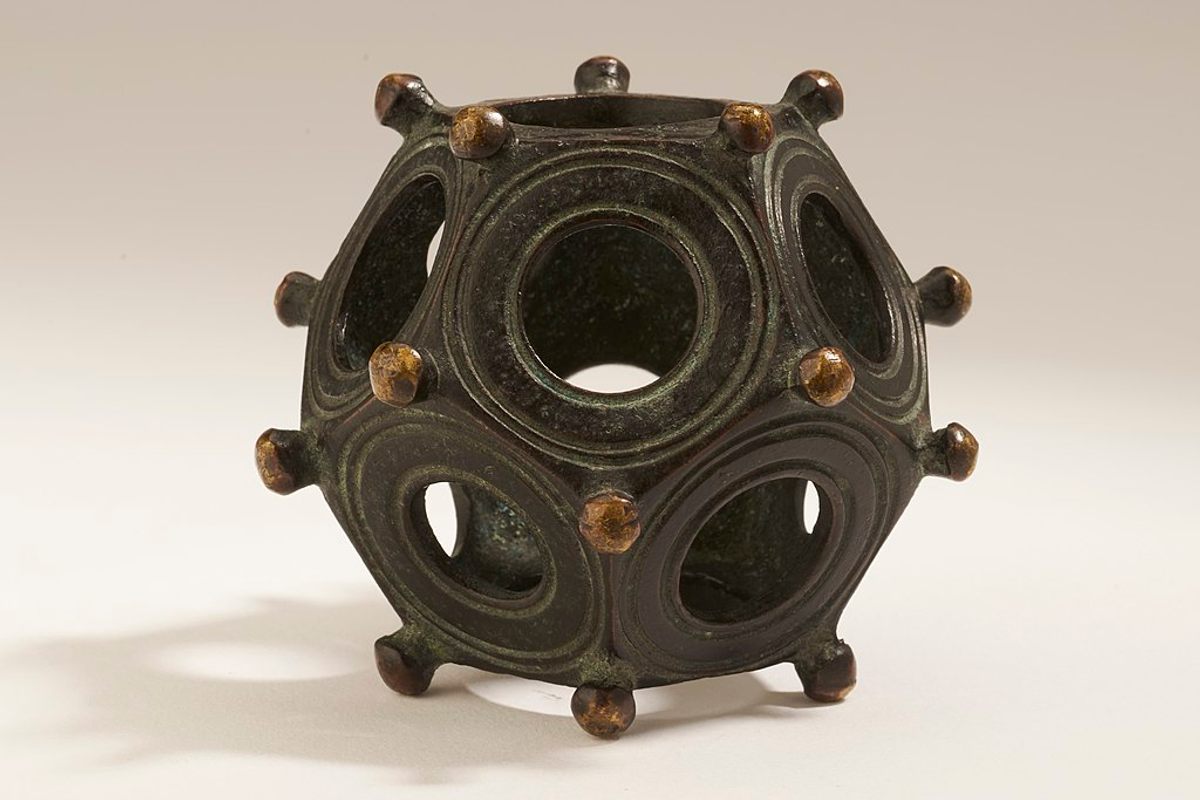
A Roman dodecahedron or Gallo-Roman dodecahedron is a small hollow object made of copper alloy which has been cast into a regular dodecahedron shape. It has twelve flat pentagonal faces with each face having a circular hole of varying diameter in the middle. The holes connect to the hollow center. The first dodecahedron was found in 1739. Since then, at least 116 similar objects have been found in Austria, Belgium, France, Germany, Hungary, Luxembourg, the Netherlands, Switzerland and the United Kingdom.
In 2023, a dodecahedron in excellent condition was found by amateur archeologists in the small village of Norton Disney in Lincolnshire, UK, bringing the total to 33 of such objects found on the territory of Roman/Britain. The objects range in size from 4 to 11 centimeters (1.6 to 4.3 in). One Roman icosahedron was misclassified as a dodecahedron. In geometry, an icosahedron is a polyhedron with 20 sides. A polyhedron is a solid shape with usually more than six sides.
The icosahedron in question was excavated near Arloff in Germany and is currently on display in the Rheinisches Landesmuseum in Bonn. No mention of dodecahedrons has been found in contemporary accounts or pictures of the time. Speculative uses include as a survey instrument for estimating distances to (or sizes of) distant objects, though this is questionable because there are no markings to indicate that they would be a mathematical instrument used as spool knitting devices for making gloves (though the earliest known reference to spool knitting is from 1535, and this would not explain the use of bronze or the apparently similar icosahedron which is missing the holes necessary for spool knitting). Some think it could be a child’s toy or just something for decorative purposes.
What is your theory?







Mark Thomas • Jun 13, 2024 at 2:01 pm
Both the dodecahedron and the icosahedron were used to Line of Sight (LOS) lines of twine to establish a military marching camp in the geometric Golden Rectangle . This established a divine space for the military from the cosmological power and authority of the objects. The icosahedron as the fourth object is dual to the dodecahedron which is the fifth object of Platonism. Both objects contain many ways of visualizing the Golden ratio and possibly methodically ray tracing the geometry to a flat terrain.